Financial Industry Business Unified Model (FIBUM)
Semantics for Object Modelers, Application Developers, and Data Architects with “other” data modeling tools -an addendum to the introduction to the ontology-derived Enterprise Data Model.
FIBO is the authoritative model of Financial Industry concepts, their definitions, and relations.
The Enterprise Data Management Council (EDMC) is the Global Association of more than 200 Financial Institutions (FI). EDMC members developed the Financial Industry Business Ontology (FIBO), a business conceptual model. FIBO is the authoritative reference standard. FIB-DM is the FIBO as a Conceptual Data Model. The Open Source core version provides more than one thousand entities derived from FIBO Foundation, Business Entities, and Finance Business & Commerce modules.
More than 100 people downloaded the model in the first three weeks since launch. Most users are from Financial Institution on PowerDesigner and ERWin data modeling tools. However, many downloaders with “other” data modeling tools cannot import the native PowerDesigner model file. Object Modelers and Application Architects need a class model.
FIBUM is the bridge across the chasm.The model file format is UML 2.2 (XMI 2.1), generated with Sparx EA.
Go to the FIB-DM download page,
https://fib-dm.com/data-model-download/, click on the download widget or menu item and follow the instructions.
We open Sparx EA and create a new project, “FIBUM import.” In the menu select Publish and click on Import XML, Import, Package from XML.
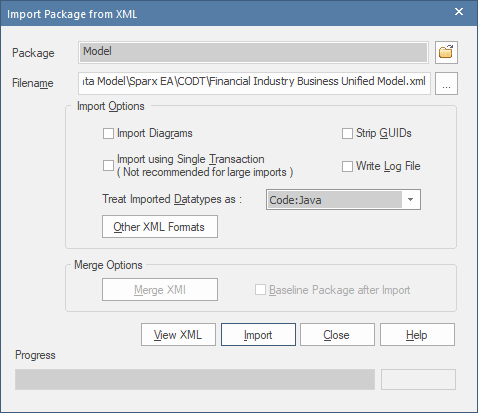
The UML XML does not contain diagrams, hence the box is unchecked.
The FIBO in Sparx Enterprise Architect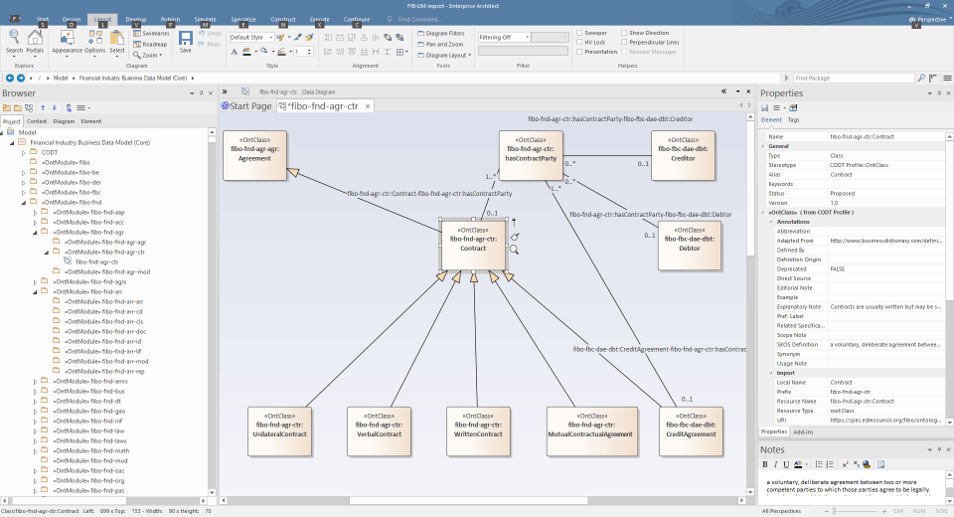
The packages in the browser reflect the FIBO module structure. Notice the CODT package and the stereotypes on packages and classes. I created the sample diagram after the import, populating with Contact classes (fibo-fnd-agr-ctr*). The model has the package hierarchy, but for compatibility with other data modeling tools, all classes are under the main model. In other words, the packages are empty.
CODT package and stereotypes
The Configurable Ontology to Data-model Transformation is the process and technology to derive models from ontologies. Tagged values are the UML equivalent to RDFS/OWL annotation properties, PowerDesigner extended attributes and ERWin user-defined properties. In UML 2, you can only apply tagged values to model elements that use a stereotype with a tag definition. The CODT profile defines stereotypes for classes and packages with tagged values for FIBO annotation properties, lineage, and semantics.
FIBUM Package properties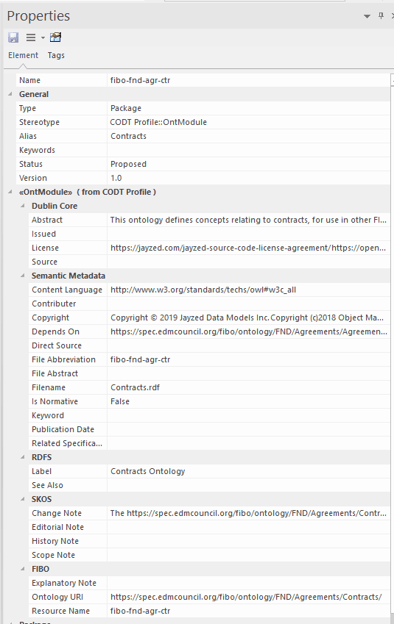
The Package name is the Prefix of the ontology module. The Stereotype is OntModule for all FIBO-derived packages. The Alias is the logical English name.
The FIBO documentation uses RDFS/OWL annotation properties:
Dublin Core
https://www.dublincore.org/specifications/dublin-core/dcmi-terms/ Semantic Metadata
http://www.omg.org/techprocess/ab/SpecificationMetadata/Resource Description Framework Schema
http://www.w3.org/2000/01/rdf-schema Simple Knowledge Organization System
https://www.w3.org/2004/02/skos/ FIBO and CODT defined annotation properties, FIBO Explanatory note, Ontology URI the lineage, traceability to the source ontology module. Resource Name, the module code, or becomes the Package Name.
FIBUM Class properties
The Class Name derived from the ontology class
Prefix:Localname. The value is the same as the FIB-DM Entity Code. The Alias is the logical English name, the same value as the FIB-DM Name. All ontology derived classes have the stereotype OntClass.
Thanks for reading.
The introduction tutorial PowerPoint is on the website:
https://fib-dm.com/tutorial-1-addendum/ For news and updates, please visit the LinkedIn page,
https://www.linkedin.com/showcase/fib-dm/


